Can you Notarize for Family in Ohio?
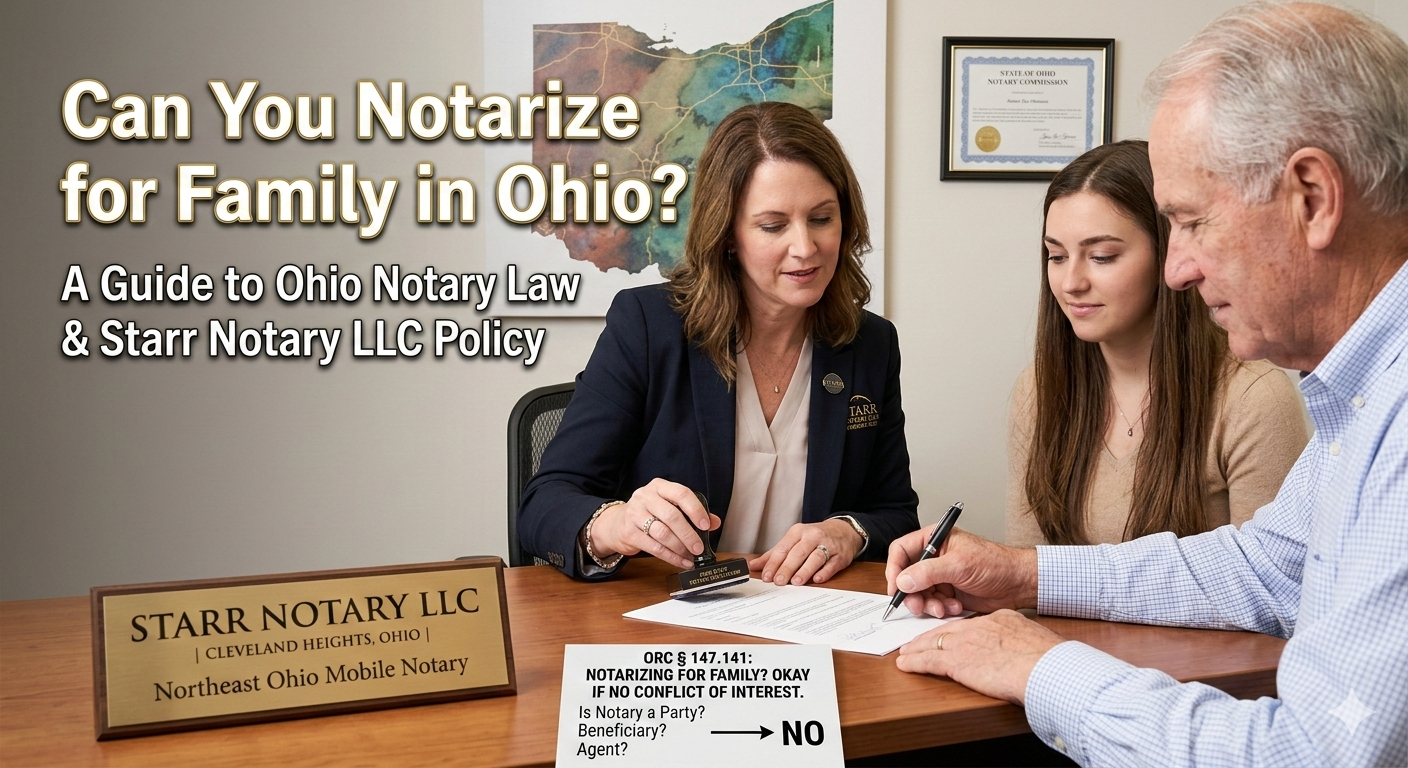
For Ohio Notaries Public, understanding the conflict of interest rule is paramount. This in-depth guide explains how Ohio Revised Code $\S 147.141$ governs notarizing for relatives, and how Starr Notary LLC maintains compliance and credibility for transactions in Cleveland Heights and all of Northeast Ohio.
The Short Answer: Can an Ohio Notary Public Notarize for a Relative?
Yes, an Ohio Notary Public can legally notarize for a spouse, child, parent, or other family member, but only if a strict condition is met: there must be absolutely no conflict of interest. The law does not contain a blanket prohibition against family notarizations. However, Ohio law places the responsibility on the notary to assess their impartiality for every single transaction, making this a "risk zone" that requires a highly professional and conservative approach.
⚖️ The Legal Framework: Ohio Revised Code $\S 147.141$
To go more in-depth, the key to this question lies not in a prohibition on family, but on a prohibition on conflicts of interest.
Ohio Revised Code (ORC) Chapter 147 governs Notaries Public. Specifically, ORC $\S 147.141$ lists the prohibited acts. Subdivision (A)(4) prohibits a notary from performing a notarial act “if the notary has a conflict of interest with regard to the transaction in question.”
What Constitutes a "Conflict of Interest" in Ohio Notary Law?
ORC\S 147.141(C) clearly defines what a conflict of interest means for an Ohio Notary Public:
Direct Financial or Other Interest: The notary has a direct financial or other interest in the transaction. (This excludes the notary fee itself, which is authorized by law.) Named as a Party: The notary is named, individually or in any capacity (such as a grantor, grantee, mortgagor, trustee, beneficiary, etc.), as a party to the transaction.
In-Depth Analysis: The Relative Test
Relationship to NotaryConflict of Interest?Notarization Permissible?Spouse, Parent, or SiblingNot automatically a conflict.Yes, IF the notary is not named in the document and has zero financial/beneficial interest.Notary is Named as BeneficiaryDefined Conflict. (Named as a party/beneficiary)
❌ No. The notary cannot be named on the document they are notarizing.Notary is Named as an Agent (e.g., on a Power of Attorney)Defined Conflict. (Named as a party in some capacity)
❌ No. Even if the document is not financially binding at the moment, being a named agent/party creates a clear conflict.Notary receives financial benefit from the transactionDefined Conflict. (Direct financial interest)
❌ No. For example, the notary's name is not on a mortgage, but they will receive money from the sale of the house.
🛑 Best Practice and Avoiding Scrutiny (E-E-A-T)
Even when technically legal, the Ohio Secretary of State advises that notarizing for close family members is a "risk zone." Why? Because the core duty of a notary public is impartiality. A notarization that is later challenged in court is less likely to stand up to scrutiny if it was performed by a family member, regardless of the notary's lack of direct interest. The appearance of a conflict—or the possibility of undue influence—can be enough to invalidate a key document. To ensure your notarized document is iron-clad and will hold up to all future legal questions, the best practice is to always use an independent, uninvolved notary.
Expert Insight: Ohio law also prohibits notarization if "it appears that the signer may be unduly influenced or coerced" (ORC § 147.141(A)(14)). The close nature of a family relationship can sometimes be perceived as having the potential for undue influence, which is another reason professional notaries often err on the side of caution.
How Starr Notary LLC Manages Notarization for Family in Cleveland Ohio
As a professional Mobile Notary Public serving Cleveland, Cleveland Heights, and all of Northeast Ohio, Starr Notary LLC is committed to a transparent and compliant process, putting your legal security first.
For every request involving a family member, we follow a strict Conflict Assessment and Disclosure Protocol:
Upfront Inquiry: We explicitly ask two essential questions before the appointment:
Are you, the Notary, named in any capacity as a party to this document (grantor, grantee, agent, beneficiary, etc.)?
Do you have any direct financial or beneficial interest in the outcome of this transaction?
Decline Policy: If the answer to either question is Yes, we must decline the notarization immediately, citing our commitment to ORC $\S 147.141$.
Journaling for Proof: If the notarization proceeds, we make a clear, detailed notation in our notary journal that the signer is a family member (e.g., "Signer is my sibling, confirmed no beneficial interest or party status") and that no conflict of interest was found. This professional documentation further solidifies the impartiality of the act.
Standard Duties Unchanged: We strictly adhere to all mandatory notarial duties:
Verify the signer's identity using valid, government-issued photo ID.
Confirm the signer is willing and mentally capable.
Ensure the document is complete and contains the proper notarial certificate (Acknowledgment or Jurat).
Why Choose an Independent Mobile Notary for Family Documents?
Hiring an independent, professional mobile notary in Cleveland adds an essential layer of Trustworthiness (the "T" in E-E-A-T) to your legal documents, such as:
- Estate Planning Documents: Wills, Trusts, and Power of Attorney (POA).
- Real Estate Transfers: Quitclaim Deeds between family members.
- Affidavits: Documents requiring a sworn statement.
By choosing Starr Notary LLC, you are selecting an impartial third party whose only interest is the integrity and legality of the notarial act, ensuring your document cannot be challenged based on the relationship between the notary and the signer.
Final Thoughts for Ohio Notaries and Signers
The goal of Ohio's notary law is not to prevent family members from getting documents notarized, but to guarantee the integrity of the notarial act. In summary: A Notary Public in Ohio must not notarize for a family member if they are a named party or have a direct financial or beneficial interest in the transaction. If you, as the Ohio notary, have any hesitation regarding your ability to be completely impartial, the only professional choice is to refer the signer to a different, independent notary. For safe, legal, and professionally documented notarizations across Cuyahoga County and surrounding areas, trust the expertise and commitment to compliance at Starr Notary LLC.
Is there an Ohio law that specifically bans a notary from notarizing for a spouse or child?
No, there is no Ohio Revised Code (ORC) section that contains a blanket ban on notarizing for a spouse, child, or other family member. The key is the conflict of interest rule found in ORC $\S 147.141$. If you are not a party to the document and have no financial or beneficial interest in the transaction, the notarization is technically permissible.
What is the most common example of a conflict of interest with family notarizations?
The most common conflict is when the notary is named as a party or beneficiary in the document.Example ❌ (Conflict): Notarizing a Power of Attorney (POA) for your parent where you are named as the Agent (the person given power).Example ❌ (Conflict): Notarizing a Quitclaim Deed transferring property from your sibling to you, the notary.In these situations, the notary is a named party, which is a clear violation of ORC $\S 147.141$.
If I am an Ohio notary, can I notarize my parent’s Will?
Possibly, but only if you are completely uninvolved. You can notarize your parent's Will if you are not named as an executor, beneficiary, or witness in the document, and you have no other direct financial interest in the estate beyond what you would normally inherit as a relative. However, because of the legal and emotional weight of Wills, it is strongly recommended to use an independent notary to prevent any future legal challenge based on the appearance of impropriety or undue influence.
Does the Ohio Secretary of State advise against notarizing for family?
While the Secretary of State does not prohibit the act, they caution that notarizing for family is a "risk zone." Professional notary associations and legal experts also advise against it as a best practice. The risk is that the notarization may be challenged later in court, with the claim that the notary could not be impartial due to the close family relationship.
What must Starr Notary LLC do before notarizing for a relative?
Starr Notary LLC must perform a detailed conflict-of-interest assessment. This includes:
Confirming the notary is not named as a party in any capacity.
Confirming the notary has no direct financial or beneficial interest in the transaction.
Documenting the relationship and the confirmation of "no conflict" in the official notary journal.
Strictly following all standard duties (verifying ID, checking willingness, etc.).
Starr Notary LLC must perform a detailed conflict-of-interest assessment. This includes: Confirming the notary is not named as a party in any capacity. Confirming the notary has no direct financial or beneficial interest in the transaction. Documenting the relationship and the confirmation of "no conflict" in the official notary journal. Strictly following all standard duties (verifying ID, checking willingness, etc.).
Using an independent, professional notary like Starr Notary LLC provides an essential layer of credibility and legal security. It ensures:
Impartiality: No one can claim the notary was biased or personally invested in the transaction.
Compliance: The notary is focused solely on fulfilling all Ohio legal requirements correctly.
Validity: The document is more likely to withstand scrutiny in a court of law, as there is no question of a potential conflict of interest.







Schedule a Mobile Notary Now